
„M230i P150 ALU/SS is already another device from Intrex at our plant. It runs reliably, and any questions are handled with a single call to service."
Labelling
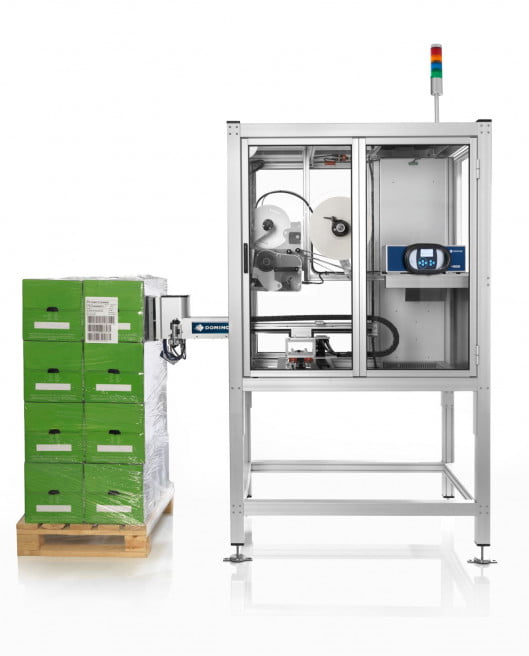
Domino M230i P150 ALU/SS
Domino M230i automated pallet labellers can be enclosed in stainless steel or aluminium cabinets. Applying labels on up to three sides in one labelling cycle and a wide variety of options make the most flexible machine on the market .
- 300 mm/s Print speed
- 150x110 mm or 150x210 mm Label sizes
- 600 m Ribbon / label length
Key benefits and features
-
Versatile. A5/A6 label application on up to three sides in a single cycle
Flexible. It can apply A5/A6 labels on up to three sides of a pallet in a single labelling cycle
-
Safe. Equipped with contactors and opening sensors during application
Safe. Labeller is equipped with reed switches and opening sensors active during label application
-
Effective. Proven Domino print module and a range of accessories enhancing labeling reliability
Effective. Proven Domino printing module and variety of options that can improve labelling reliability
-
GS1 compliant. Software enabling implementation of the SSCC logistic unit identifier
GS1 compliant. Its software allows to produce fully compliant Serial Shipping Container Code (SSCC)
Downloads
-
EN-M230i-range
Technical data
| Printing technology | Thermal transfer or direct thermal |
|---|---|
| Resolution | 300 dpi (12 pkt/mm) or 200 dpi (8 pkt/mm) |
| Speed | 18 seconds (2labels on adjacent sides) 13 seconds (1 label onto front or rear ) 5 seconds (1 label on side) |
| Print speed | 300 mm/s |
| Label size | 150x110 mm or 150x210 mm |
| Label application | Front, side , rear labelling |
| Ribbon and label web length | 600 m |
| Optional user interface | TouchPanel |
Domino M230i P150 ALU/SS
Zobacz urządzenia w akcji
Why M230i P150 ALU/SS?
Key product advantages
-
Universal. A5/A6 label application on up to three sides in a single cycle
-
Safe. Equipped with contactors and opening sensors during application
-
Effective. Proven Domino printing module and a range of accessories increasing labeling reliability
-
Compliant with GS1. Software enabling implementation of SSCC logistic unit identifier
Customer Reviews
What do companies that chose M230i P150 ALU/SS say?
„Integrating M230i P150 ALU/SS with our line went without downtime. I appreciate the Intrex engineers’ help during startup and operator training."
„Above all, we expected reliability from M230i P150 ALU/SS – and we were not disappointed. A year of intensive work, zero unplanned stops."
Labelling
Products in category labelling
Want to know if M230i P150 ALU/SS is right for your business?
Our expert will analyze your line and select the optimal solution. Free consultation - no obligation.
How we help manufacturing companies grow
Automatic Labeling System for a Mineral Water Manufacturer from the Arabian Peninsula
A leading manufacturer of mineral water and beverages based in Dubai launched mineral water in 5-liter PET bottles on the market. Challenges facing the team: Why this Intrex solution? This project demonstrates that even an unusual shape and large product dimensions don’t have to stand in the way of high labeling performance — the right […]
Read case study
Intrex Labeling System for High-Speed Bottling Lines at Browar Sulewski
For our client in the beer production industry, we designed a solution for labeling glass bottles around their circumference, combined with thermal transfer printing. Browar Sulewski was founded in 2010, in a building that once housed an old military casino. Starting out as a small family brewery combined with a restaurant and pub, it now […]
Read case study
Can Labeling – A Solution for the Danish Brewery ÅBEN
INTREX SET 1101 Plus — a versatile solution for labeling cans and bottles, which was enhanced with a dedicated feeding table at the customer’s request. ÅBEN is an award-winning Danish brewery whose very name means “openness”. The brewery’s philosophy is built around openness — from the brewing process itself to openness toward creative partnerships and […]
Read case study